


Imagine receiving medical consultations from the comfort of your home. A smartphone and a stable internet connection are the only things needed. This is the essence of telemedicine.
Gone are the days when every health concern required an in-person hospital visit. Today, many medical providers recommend telemedicine consults for non-emergency cases where visiting a clinic may not be necessary.
In the last few years, telemedicine use has increased. The global telemedicine market is expected to reach $380 billion by 2030. The COVID-19 pandemic and the subsequent widespread lockdown propelled this growth.
A telemedicine app is the front end for a remote clinical meeting- video calls, secure messaging, appointment scheduling, and e-prescriptions in one place. Patients, providers, and administrators share the same platform.
The terms telehealth and telemedicine are used interchangeably. Telemedicine refers specifically to remote clinical services: Diagnosis, treatment, and prescriptions delivered by licensed providers. Telehealth is a broader term covering non-clinical services too – patient education, wellness programs, remote monitoring, and administrative functions. Understanding this distinction matters because it shapes your compliance requirements and feature scope.
Key Takeaways
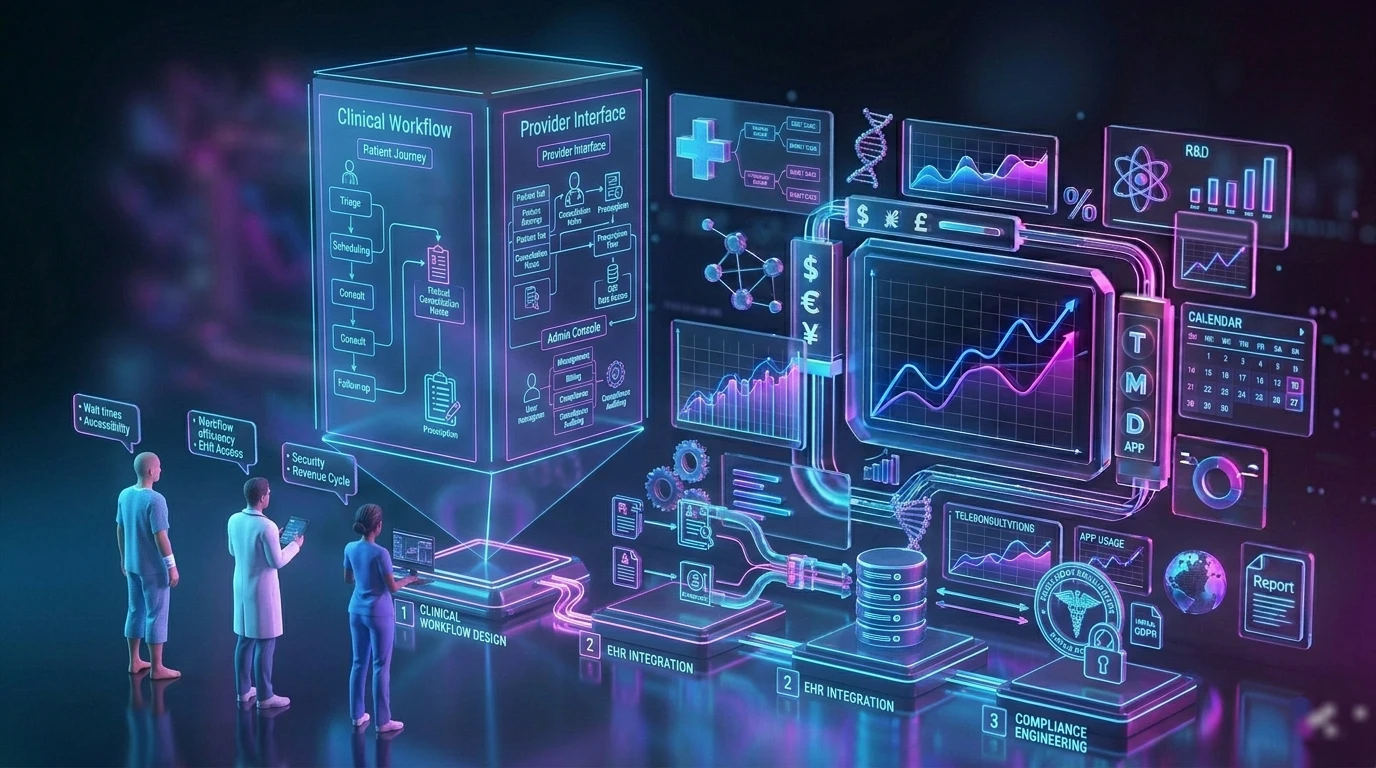
- Telemedicine app development in 2025 is not simply video calling with a privacy policy. It requires clinical workflow design, EHR integration, and compliance engineering from day one
- A well-built platform primarily serves three distinct user groups: patients, providers, and administrators. Each has different needs that can’t be treated as an afterthought.
- Development follows a defined sequence. Skipping steps doesn’t save time; it shifts the cost downstream.
- Costs run from $30K for a basic MVP to $400K-plus for an enterprise custom solution, depending on complexity
- The vendor decision matters as much as the technical build. The wrong development partner costs more in remediation than you saved on development fees.
- HIPAA and GDPR are not simply legal formalities but architectural requirements with serious financial penalties.
Table of Contents
- Core Features of a Modern Telemedicine App
- How to Develop a Telemedicine App: Step-by-Step
- Telemedicine App Development Cost
- Telemedicine App Development Solutions for Different Healthcare Businesses
- Telemedicine Mobile App Development Technologies
- Compliance and Security in Telemedicine Software Development
- Best Practices for Successful Telemedicine App Development Solutions
- Challenges in Telemedicine Application Development
- Future of Telemedicine Software Development Services
- Real-World Use Cases
- How to Choose a Telemedicine App Development Company
- How Experion Technologies Is a Trusted Telemedicine App Development Partner
- Conclusion
- Frequently Asked Questions
Core Features of a Modern Telemedicine App
Platform needs to cater to three distinct user groups: Patients, doctors, and system administrators.
The Patient App Experience
Most patients do not read documentation or attend training sessions. If they can’t figure out how to book an appointment in under two minutes, many of them won’t come back. So the patient side of the platform has to be both secure and completely frictionless.
- Simple Registration & Profiles: A streamlined onboarding process is essential. Most telemedicine apps support Multi-factor authentication (MFA), Biometric login using fingerprint or facial recognition, Secure patient profile management, Structured medical history records, and storage of insurance and emergency contact information.
- Doctor Search and Appointment Scheduling: Patients should be easily able to search for healthcare professionals based on:
a. Specialization
b. Availability
c. Consultation fees
d.Languages spoken
e. Ratings and reviews
In addition, there should be real-time scheduling systems that allow efficient scheduling and a view of doctor availability across multiple time zones.
- High-Definition Video Consultation & Chat: Secure communication includes HD video consultations, File and report sharing, and End-to-end encryption. Numerous platforms use WebRTC technology to deliver secure video consultations through web applications.
- Secure Payment Integration: Integrated payment systems simplify the consultation process for healthcare providers. Telemedicine apps support
a. Credit and debit cards
b. Digital wallets
c. UPI and localized payment methods
d. Insurance claim processing
e. Automated invoice generation - Notifications and Reminders
Automated notifications help improve patient appointment engagement through various means, such as Appointment reminders, Prescription alerts, Follow-up notifications, Payment confirmations,and Health monitoring alerts.
- Doctor and Patient Ratings and Reviews: Let patients choose doctors based on previous reviews and user experiences.
- Emergency Service Integration: Some advanced telemedicine platforms integrate with emergency response systems, allowing patients to quickly access emergency contacts or ambulance services during critical situations.
The Doctor App Experience
A well-designed doctor’s interface lets the healthcare professional focus more on patient care and less on manual processes.
- Verified Professional Profiles: The doctor’s profile should display all of their Medical qualifications, Clinical specializations, certifications, licenses, and Years of experience. Verified profiles improve trust and credibility.
- EHR/EMR Integration: Direct access to Electronic Health Records (EHR) to review medical histories and log diagnostic notes during a consultation.
- E-Prescribing Tools: Digital prescription systems enable doctors to generate and share prescriptions electronically with pharmacies or patients directly. This reduces paperwork and improves the efficiency of prescription management.
- Calendar Management: Dynamic scheduling dashboards to manage clinical hours, track completed sessions, and avoid double-booking.
- Consultation notes: Platforms should allow doctors to securely record clinical observations, diagnoses, treatment plans, and follow-up recommendations during or after consultations.
- Specialist Referrals: This feature allows a general practitioner to refer a patient to a specialist.
The Admin Dashboard
The admin dashboard acts as the operational backbone of the telemedicine platform.
- User Management: Admins handle many functions- Patient account management, Role-based permissions, Secure data backups, and doctor credential verification.
- Analytics and Billing: These tools help generate financial invoices, track consultation volumes, and monitor overall app performance metrics.
- Content moderation: Admins should also be able to manage inappropriate content, fake profiles, and user-reported issues.
- Compliance monitoring: Healthcare platforms must continuously monitor compliance with regulations such as HIPAA, GDPR, and regional healthcare laws.
Advanced Features
- Remote Patient Monitoring: Wearable and device integrations that stream biometric data(blood glucose, cardiac metrics, blood pressure) directly into patient records. This is where telemedicine shifts from episodic care to ongoing clinical management.
- Multi-language support: Supporting multiple languages improves accessibility and serves diverse populations across different regions.
- Voice assistance: AI-powered voice assistants can help users book appointments and set medication reminders. Voice support improves accessibility for elderly users and patients with disabilities.
- Group Consultations: Some platforms also support multi-user consultations, in addition to patient consultations. These may be their family members, caregivers, etc.
How to Develop a Telemedicine App : Step-by-Step?
Step 1: Market Research & Compliance Planning
Define your target population clearly before anything else. Analyze competitor platforms to identify gaps your platform can fill. Most importantly, consult with regulatory experts before design begins to map your specific compliance requirements.
HIPAA obligations vary based on your data architecture. Discovering a structural compliance gap six months into development is expensive.
Step 2: UI/UX Prototyping
Healthcare apps have a user problem that most product teams skip past: your users might be scared, in pain, or have never opened a smartphone app before.
The standard checklist – large tap targets, high-contrast visuals, simple navigation, low cognitive load – exists for real reasons. An anxious patient waiting for test results won’t work around a cluttered interface. An elderly user with a tremor can’t reliably hit a 32px button. These aren’t edge cases; they’re your core users.
WCAG 2.1 (Web Content Accessibility Guidelines) is the baseline standard for accessibility across visual, hearing, and cognitive impairments. Most teams treat it as a compliance audit before launch. It should be in the design brief from day one, sitting next to the wireframes.
Step 3: Architecture Design & Tech Stack Selection
A production-ready telemedicine technology stack typically includes:
| Layer | Recommended Technologies | Purpose |
| Frontend | React Native, Flutter | Cross-platform telemedicine mobile app development for iOS and Android |
| Backend | Node.js, Python (Django/FastAPI), .NET | Business logic, APIs, authentication, scheduling, and data processing |
| Database | PostgreSQL, MongoDB | Structured patient records and flexible medical document storage |
| Video Infrastructure | Twilio Video, Agora, WebRTC | Secure HD video consultation and real-time communication |
| Cloud Infrastructure | AWS HealthLake, Azure Health APIs, Google Cloud Healthcare API | Scalable healthcare cloud hosting and compliant data management |
| Security Layer | AES-256 Encryption, OAuth 2.0, Two-Factor Authentication | Protection of sensitive healthcare and patient information |
| Interoperability Standards | HL7 FHIR, DICOM | Secure EHR/EMR integration and medical imaging compatibility |
In case consultations grow, the platform should be able to match accordingly. Hence, the architecture should be cloud-native and microservice-ready. A well-planned telemedicine application development architecture improves performance and enables faster future feature expansion.
Step 4: MVP Development & Third-Party Integrations
Begin by developing the Minimum Viable Product (MVP). Start with the three core workflows: video consultation, appointment scheduling, and payment processing.
A focused MVP reaches clinical users faster and generates real feedback quickly. It reduces the investment risk of building features that nobody needs. EHR integrations should run in parallel as a workstream.
Step 5: QA Testing and Security Audits
Simply performing functional testing is not enough, especially when it comes to a platform that handles medical data. Penetration testing, vulnerability scanning, load testing under concurrent user conditions, and user acceptance testing with actual clinical staff are all required before launch.
Load testing is particularly important to ensure stable video consultation performance during concurrent usage spikes.
Step 6: Deploy and maintain the app
Deployment is only the beginning of the telemedicine app development lifecycle. Continuous monitoring, maintenance, and optimization are essential for long-term platform stability.
Post-launch activities typically include:
- Performance monitoring
- Security patching
- Infrastructure scaling
- Bug fixing
- Analytics tracking
Healthcare regulations, user expectations, and technology standards evolve continuously.
Whether you are building for a multi-specialty hospital network or a single-specialty clinic, Experion’s telemedicine app development services are architected around your specific care model.
Telemedicine App Development Cost
The overall cost depends on feature complexity, platforms supported, integration requirements, compliance architecture, and your development team’s location. Here’s a realistic breakdown:
| App Type | Key Features | Estimated Cost |
| Basic MVP | Video consult, scheduling, payments | $30,000 – $60,000 |
| Mid-Complexity Platform | Full features, EHR integration, RPM | $60,000 – $150,000 |
| Enterprise Custom Solution | Multi-specialty, AI features, full compliance | $150,000 – $400,000+ |
Key cost drivers include the depth of EHR integration, compliance architecture requirements, number of platforms (iOS, Android, web), real-time video infrastructure, and third-party API licensing.
Another factor is Build vs. Buy: White-label telemedicine platforms are cheaper upfront but underdeliver for organizations with specific clinical workflows, scaling ambitions, or compliance requirements. Custom telemedicine app development solutions deliver better long-term economics for any organization planning to grow.
Not sure what your telemedicine platform will cost?
Get a free estimate from Experion
Telemedicine App Development Solutions for Different Healthcare Businesses
There’s no universal telemedicine platform. What a hospital network needs looks very different from what a pediatric practice or a corporate wellness program needs. Getting this right means understanding the care model before scoping the features.
Hospitals and Clinics
Multi-provider scheduling, department-level analytics, deep EHR integration, and multi-location management are crucial for hospital networks. Platform uptime must be maintained, as it is a clinical operations requirement. When a hospital’s telehealth system goes down, patient care is affected.
Mental Health and Therapy Platforms
Mental health platforms carry risks that most healthcare apps don’t. A leaked medication list is damaging. A leaked therapy transcript – or a crisis flag tied to someone’s name – is a different kind of harm.
HIPAA is a starting point. These apps deal with mood tracking data, asynchronous messages between sessions, and crisis escalation flows. Each has its own exposure surface. Who can see a patient’s mood logs? How does a crisis flag get routed without leaking context to the wrong clinician? These aren’t hypothetical questions.
Therapist credentialing is easy to deprioritize in early builds. It shouldn’t be. Verifying licenses, tracking expiry, logging who reviewed what – these feel like admin problems until something goes wrong, at which point they become legal ones.
Fitness and Wellness Apps
Though these apps sit at the telehealth end of the spectrum, the core requirements overlap. These include wearable integrations, personalized recommendation engines, and nutrition or fitness tracking alongside optional practitioner consultations.
Elderly Care and Chronic Disease Management
Accessibility is the primary design constraint, not an afterthought. Large fonts, simplified navigation, voice assistance, and caregiver access features determine whether elderly patients actually use the platform. RPM integrations for blood pressure, glucose levels, and cardiac metrics are central to the clinical value.
Pediatric Telemedicine Platforms
Parental consent workflows, a child-friendly UI, pediatric-specific clinical templates, and growth-tracking modules make this a genuinely specialized build. For these platforms, Generic telemedicine development experience isn’t enough – the clinical requirements are specific, and the regulatory obligations around minors add additional complexity.
Corporate Healthcare Solutions
Corporate healthcare solutions require
- HR system integrations
- Anonymized aggregate health analytics for employers
- Seamless insurance billing
- Low-friction appointment booking.
Employee adoption is the metric that determines whether a corporate telehealth program survives its first contract renewal. Speed to appointment matters more here than almost anything else.
Telemedicine Mobile App Development Technologies
Native vs Cross-Platform Development
Most mobile app developers face this dilemma: Native vs. cross-platform development. Native development – Swift for iOS, Kotlin for Android – gives you the highest performance ceiling and the deepest device integration. It also doubles your development effort and your maintenance cost going forward.
For most telemedicine mobile app development projects, cross-platform development frameworks like Flutter or React Native deliver 80 to 90 percent code reuse with performance good enough for clinical use. The cases where native is worth the premium are platforms with complex hardware integrations or very demanding real-time requirements.
Cloud Infrastructure for Telehealth Apps
Cloud infrastructure such as AWS HealthLake, Azure Health APIs, and Google Cloud Healthcare API are built especially for this. It natively supports FHIR, including HIPAA-eligible service configurations, and significantly reduces compliance engineering overhead compared to building on generic cloud infrastructure. The cloud platform choice is a long-term architectural decision; migrating later is expensive.
AI and Machine Learning Integration
Some features include:
- Symptom checkers that route patients to appropriate care levels before any physician is involved
- Drug interaction flagging during e-prescribing
- Ambient documentation AI that converts consultation audio to structured clinical notes
IoT and Wearable Connectivity
Apple Watch, Fitbit, CGM devices, and connected blood pressure monitors – these extend clinical value beyond the consultation window in ways that genuinely change care models for patients with chronic disease. This is where telemedicine starts to look less like a digital replacement for in-person visits and more like something new.
Cybersecurity Technologies in Telemedicine
Cybersecurity is the most critical aspect of telemedicine software development. Since Healthcare platforms handle highly sensitive patient data, they are a prime target for cyberattacks.
Key cybersecurity technologies used in telemedicine platforms include:
- Zero-trust security architecture: In a zero-trust security architecture, every user, device, and API request is continuously authenticated and validated before access is granted.
- AES-256 encryption for data in transit and at rest: Advanced Encryption Standard (AES-256) protects patient data in transit and at rest. Hence, sensitive medical records, video consultations, prescriptions, and messages remain protected from interception or breaches.
- OAuth 2.0 for API authentication: OAuth 2.0 provides secure authorization for APIs without exposing user credentials.
- DDoS protection: Distributed Denial-of-Service (DDoS) attacks can overwhelm healthcare systems and disrupt access to critical medical services. Robust DDoS protection mechanisms help ensure platform availability and business continuity.
Compliance and Security in Telemedicine Software Development
HIPAA Compliance Requirements
Any US-market telemedicine platform that handles Protected Health Information (PHI) must be HIPAA-compliant.
In engineering terms, that means:
- End-to-end encryption
- Role-based access controls limiting PHI to authorized personnel,
- Detailed audit logs of every access event
- Business Associate Agreements with every third-party vendor in the stack
- Documented breach notification procedures.
Non-compliance penalties often reach $1.9M per violation category annually.
Is your telemedicine platform HIPAA-ready?
Get a free compliance review from Experion
GDPR and Regional Data Regulations
If European patients use your application, you are subject to GDPR obligations.
- Explicit consent before data collection
- Defined data residency,
- The right to erasure
- Breach notification within 72 hours.
Australia’s Privacy Act, Canada’s PIPEDA, and India’s DPDP Act have comparable requirements.
The safest architectural strategy is to build to the most stringent applicable standard from the start. Retrofitting compliance into a platform that wasn’t designed for it is significantly more expensive.
End-to-End Encryption
Patient data, whether in transit or at rest, requires AES-256 encryption or its equivalent. Video sessions must be encrypted end-to-end, and server-side recording should not happen without explicit patient consent documented in the system.
Secure Payment Processing
PCI DSS compliance is required for any platform processing card payments. Tokenizing payment data and physically separating payment infrastructure from clinical data systems significantly reduces the risk of breaches. These two systems should not share infrastructure.
Authentication and Access Control
Telemedicine platforms should support Multi-factor authentication (MFA) for all users, biometric login on mobile devices, and granular role-based access Control (RBAC) that restricts PHI access strictly to authorized roles.
Healthcare organizations must adopt the principle of least privilege, granting users only the minimum level of access required to perform their responsibilities.
Data Backup and Disaster Recovery
A reliable telemedicine platform should include automated daily backups, geographically distributed data redundancy, and tested disaster recovery plans with defined Recovery Time Objectives (RTO).
In clinical operations, a four-hour RTO is the standard. Unlike traditional software outages, failures in healthcare systems carry real-world consequences, where availability and reliability become patient-safety concerns.
Best Practices for Successful Telemedicine App Development Solution
- Prioritize user-friendly design– Ensure that you design keeping in mind the least tech-savvy user on your platform. Complexity kills adoption faster than any technical failure.
- Ensure HIPAA/GDPR-style compliance as applicable-Treat compliance as architecture. HIPAA requirements need to be incorporated into the data model and the access layer from day one.
- Use scalable architecture– Build infrastructure for high volume early on. Healthcare platforms scale in unpredictable bursts. Perhaps it could be a major employer signing on, a news story, or even a health crisis. Regardless of the volume, the platform needs to hold up.
- Focus on accessibility for all age groups-WCAG 2.1 accessibility standards expand your usable patient population and improve the experience for everyone else, too.
- Plan for continuous updates and support: Plan the post-launch roadmap before launch. Telemedicine platforms need ongoing iteration as regulations change, devices evolve, and clinical workflows shift.
- Test with real clinical staff: Run user acceptance testing with them. A physician will find workflow problems in one session that QA engineers will never find.
Challenges in Telemedicine Application Development
Data Privacy and Security Risks
Healthcare data has a higher black-market value than financial data, and telemedicine platforms are specifically targeted for it. Phishing, ransomware, and API exploitation are the most common vectors. Security is a continuous operational discipline.
Video Streaming Performance Issues
Variable network quality – particularly in rural areas where telemedicine often matters most – can make a consultation clinically useless. Adaptive bitrate streaming, audio-only fallback modes, and low-bandwidth optimization need to be in the architecture from the start.
Regulatory Compliance Challenges
Healthcare regulations vary across states and countries in ways that aren’t always obvious until you’re mid-build. A platform fully compliant in California may need structural changes to serve patients in Germany. Factoring in the most stringent applicable standard from the beginning is the safest architecture decision.
User Adoption and Accessibility
Healthcare technology adoption is slow, and the reasons are usually practical rather than irrational. Physicians are already overwhelmed with documentation. Elderly patients may never have used a smartphone for any medical purpose. Intuitive onboarding, in-app guidance, and genuinely responsive support are as important as the features themselves for real-world adoption.
Integration with Legacy Healthcare Systems
Many hospitals still run EHR systems that are decades old and were never designed for API-based integration. This is consistently the most technically complex part of telemedicine application development. It’s also the most frequently mis-scoped.
Get an honest assessment of your EHR integration complexity before finalizing any budget or timeline.
Future of Telemedicine Software Development Services
- AI-powered symptom checking: Report your symptoms to the system. It then utilizes Natural Language Processing and Machine Learning to analyze your symptoms and route to appropriate care. These platforms use a combination of chatbots and live video. The software allows integration with existing EHR systems and integrates with the medical database.
- Remote diagnostics and wearable integration: In a traditional setting, patient diagnosis involves collecting vital signs and tests to identify disease. In telehealth apps, the data is collected using wearable tech with remote health monitoring. Let’s take the example of a wearable device such as a smartwatch. The smartwatch is connected to the smartphone and collects data on vitals such as heart rate, sleep patterns, etc. This allows healthcare professionals to monitor their health.
- Personalized care recommendations: Future telemedicine applications can use patient history and lifestyle data to deliver personalized recommendations. Customized wellness plans, medication reminders, personalized diet, and fitness recommendations can improve overall health outcomes.
- Growth of telemedicine app development solutions in hybrid healthcare models: The future of healthcare is expected to follow a hybrid care model. It combines in-person treatment with virtual healthcare services. Hospitals are increasingly adopting telemedicine app development solutions that support both physical and remote consultations within a unified ecosystem.
- AR/VR in Remote Consultations: Augmented and Virtual Reality technologies are entering telemedicine software development. Potential use cases include AR-assisted surgical collaborations, virtual therapy sessions, and medical simulations and training. AR and VR can make remote healthcare interactions more interactive and clinically effective.
- Blockchain for Medical Records: Blockchain technology is used in healthcare to create blockchain-based medical records. These records are tamper-proof audit trails and enable cross-institutional data sharing without centralized custodians.
- Predictive Healthcare Analytics: Predictive Analytics can help analyze historical and real-time patient data. This analysis can identify potential health risks before conditions become severe. Predictive healthcare systems can assist with early disease detection and risk assessment. This proactive approach can improve patient outcomes while reducing healthcare costs.
Real World Use cases
- Rural hospital expanding specialist access via telemedicine mobile app
E-Sanjeevani is India’s National Telemedicine Service. It connects patients at local Wellness Centers with specialists at hub hospitals. Launched in November 2019, it provides specialized care in rural and isolated areas. The platform became especially important during and after the COVID-19 pandemic, accelerating nationwide telemedicine adoption.
- Mental health startup scaling with custom telemedicine application
A notable real-world use case of telemedicine in mental healthcare is the rise of digital mental health startups. It helps connect patients with licensed psychologists and therapists remotely.
These platforms help users:
- Find trusted and verified mental health professionals.
- Book online therapy sessions conveniently
- Reduce the need for frequent in-person consultations.
- Maintain confidentiality through secure video consultations.
A Custom telemedicine app development solution is especially valuable in mental healthcare, as many users prefer discreet, accessible treatment options. Features such as anonymous onboarding, secure messaging, appointment scheduling, digital prescriptions, mood tracking, and virtual counseling sessions are useful.
- Chronic disease management via RPM-enabled platform
A diabetes care provider integrated continuous glucose monitors with a patient-facing telemedicine platform, so clinical teams could see real biometric data during consultations rather than relying on patient recall. The result was measurable HbA1c improvement in 73% of their managed patient cohort.
- Corporate employee wellness program via telehealth app
A Fortune 500 company replaced its employee health benefits hotline with a custom telehealth app. Absenteeism dropped. Employee satisfaction scores for healthcare benefits went up. The app paid for itself in reduced insurance claims within two years.
How to Choose a Telemedicine App Development Company?
Choosing a software development partner with the proper expertise shapes every major outcome in this project.
What to look for:
- Healthcare domain expertise and compliance track record– Search for companies with experience building healthcare or telemedicine solutions. Their expertise should not just be limited to general mobile or SaaS applications. Enquire about specific clinical workflows they have built or patient engagement scenarios they have handled.
- Portfolio of HIPAA-compliant applications: Request for real-world examples of compliant healthcare applications along with verifiable client references.
- EHR integration experience: Integration complexities vary across EHRs such as Epic, Cerner, and Athenahealth. Development teams should have demonstrated hands-on interoperability experience with the specific healthcare systems your organization already uses.
- Post-launch support model and SLA commitments: Telemedicine platforms often require ongoing monitoring and compliance maintenance. Evaluate whether the vendor provides long-term support agreements and incident management services.
Key questions to ask before signing:
- Can you connect me with a client who had similar requirements to ours?
- Who owns compliance engineering: your internal team or a subcontractor?
- How do scope changes get handled mid-build, and what does that cost?
- What does your support model look like 12 months after launch?
Red flags to avoid:
- No healthcare-specific client references
- Fixed-price bids submitted before the discovery is complete
- Compliance is framed as a final phase rather than an architectural foundation
- No dedicated security testing capability
How Experion Technologies Is a Trusted Telemedicine App Development Partner?
With extensive experience as a telehealth app development company, Experion’s technical team specializes in developing functional, practical solutions. Having a proven track record across the US, UK, and APAC markets, our team focuses on building intuitive healthcare ecosystems that improve accessibility and patient engagement.
One notable example of our telehealth software development expertise is the teleconsultation platform we developed for a leading health and wellness organization. The solution enabled virtual consultations, appointment scheduling, online payments, and remote diabetes management through mobile applications for both patients and doctors. The platform helped improve healthcare accessibility during the COVID-19 period.
Conclusion
Telemedicine isn’t a future capability that healthcare organizations should start planning for. It’s a critical infrastructure that healthcare organizations need to be running well right now. The organizations that invested early have gained benefits in patient reach, clinical capacity, and operational efficiency. Virtual-first care is becoming the baseline expectation and not a differentiator.
The fundamentals include: Building for compliance, designing for the patient, and architecting for large scale. What changes with each passing year is how much harder it becomes to catch up with organizations that got started earlier.
Choosing the right telemedicine app development company is the most important decision in this process. The right development partner helps healthcare organizations build future-ready telemedicine ecosystems from the ground up.